Τι είναι η Ιδεοψυχαναγκαστική Διαταραχή (ΙΨΔ) ;
OCD is a neuropsychiatric condition estimated to affect around 1–3% of the general population. It is often mistakenly associated only with cleanliness or symmetry. In reality, OCD encompasses a wide and complex range of symptoms that can vary greatly from person to person. Due to its severity and impact, the World Health Organization ranks OCD among the ten most disabling illnesses, as it can profoundly affect personal, social, and professional life.
According to the DSM-5 (Diagnostic and Statistical Manual of Mental Disorders, 5th Edition), OCD is characterized by: Obsessions involuntary, unwanted, repetitive, intrusive thoughts, images, or urges that cause intense distress and Compulsions, repetitive physical or mental behaviors that the individual feels driven to perform in order to temporarily relieve the distress caused by obsessions (DSM-5, 2013).
It is important to clarify that many people have habits or small routines that resemble rituals such as aligning objects, organizing in a specific way, or preferring tasks to be done in a certain order.
These behaviors alone do not indicate OCD. Similarly, the commonly used phrase “we’re all a bit OCD” while often said casually or humorously reflects a misunderstanding and contributes to stigma around a condition that can be profoundly debilitating for those who live with it.
The essential differences in OCD lie in:
• the intense distress caused by obsessions and compulsions.
• the significant impairment in daily functioning, including work,
relationships, and self-care.
• the time-consuming nature of the symptoms, which often occupy more than an hour a day and frequently much longer.
OCD is not about being “tidy” or “perfectionistic.” It is a serious neuropsychiatric disorder that requires understanding, accurate diagnosis, and specialized treatment.

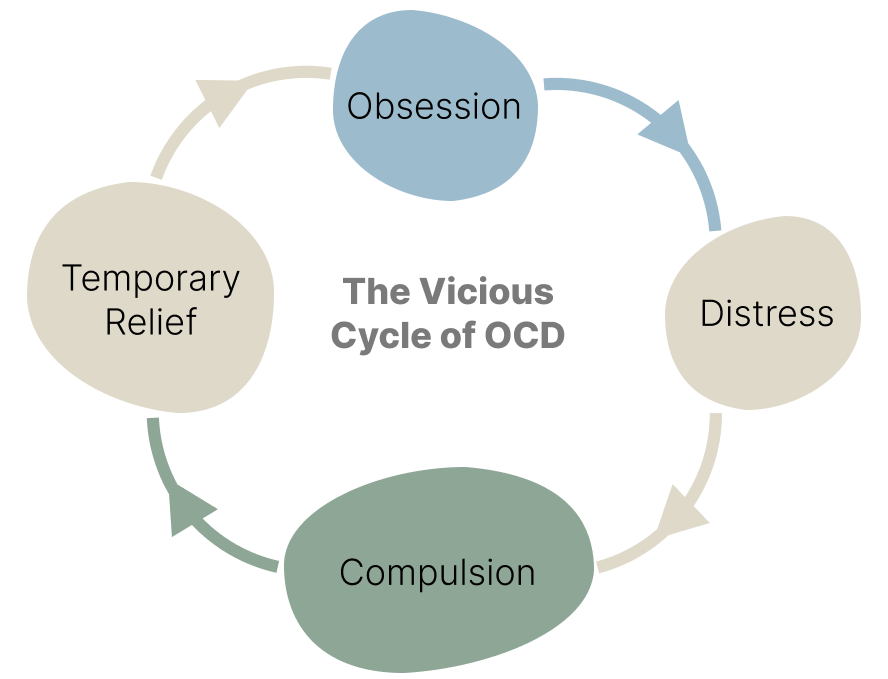
The Vicious Cycle of OCD
OCD operates through a repetitive vicious cycle that maintains and reinforces the disorder over time. Briefly, this cycle could be described as follows:
- Obsession: An involuntary, intrusive, and unwanted thought, image, or urge suddenly arises, causing intense anxiety, fear, or guilt.
- The obsession generates anxiety: The person experiences distress and tension, often with the feeling that “something bad might happen.”
- Compulsion: In an attempt to reduce this anxiety, the person engages in a repetitive behavior or mental act (e.g., checking, cleaning, counting, praying)
- Temporary relief: The compulsion temporarily reduces anxiety but, in the long run, establishes the ritualistic behavior.
- Repetition of the cycle: The next similar thought can cause even stronger anxiety, and the compulsion may repeat more often or with greater intensity.
Over time, this cycle becomes increasingly restrictive, affecting the person’s daily life and functioning.
Understanding this vicious cycle is the first step toward addressing OCD.
Sources:
• American Psychiatric Association. (2013). Diagnostic and statistical manual of mental disorders (5th ed.).
• Pampaloni, I., Marriott, S., Pessina, E., Fisher, C., Govender, A., Mohamed, H., Chandler, A., Tyagi, H., Morris, L., & Pallanti, S. (2022). The global assessment of OCD. Comprehensive psychiatry, 118,
• Ruscio, A. M., Stein, D. J., Chiu, W. T., & Kessler, R. C. (2010). The epidemiology of obsessive-compulsive disorder in the National Comorbidity Survey Replication. Molecular Psychiatry, 15(1), 53–63.